
- Articles
- Insights
Feeling Bullish or Bearish on Banks? Make a Play During Earnings Season
May 7, 2026Quarterly tech earnings get a lot of attention across North America, but in Canada, the reporting that really matters comes from century-old operations: the Big Six banks. That includes RBC, TD Bank, BMO, Scotiabank, CIBC and the National Bank of Canada.
These financial institutions are massive, accounting for five of the top 10 largest companies on the S&P/TSX Composite Index and roughly two-thirds of the S&P/TSX Capped Financials Index.
With such a significant weighting at the top of the index, any movement in bank stocks can have a notable impact on the sector and the broader Canadian market. That’s often the case during earnings season, which presents opportunities for traders who want to capitalize on sector volatility with leveraged, inverse, and inverse-leveraged ETFs.
A compressed earnings window
One reason earnings seasons can draw attention is that Canadian banks tend to report earnings on a compressed schedule. With results arriving within days of one another, an early report from one bank can shape expectations for the rest of the sector, moving prices ahead of earnings and setting the stage for reversals if later reports don’t fit that narrative.
Earnings seasons give traders a short window to make the most of leveraged and inverse strategies around bank earnings season.
Build conviction ahead of bank earnings
To trade bank earnings, you’ll want to come up with a view of where their numbers might go before they report. Fortunately, many of the pressures banks face show up in economic data weeks or even months before earnings season. Here’s what to look for:
- 1. Employment
Rising unemployment rates or a steady increase in jobless claims can point to higher loan losses ahead, particularly in consumer credit and unsecured lending. If households are under pressure, banks may respond by setting aside more money to cover potential defaults, which can weigh on earnings. That shows up as higher loan loss provisions.
Impact on trade: Because provisions for credit losses are forward-looking, higher-than-expected numbers can pressure bank stocks, even if other parts of the business remain strong. - 2. Inflation
Inflation data also matters, though not always in obvious ways. Persistent inflation can squeeze borrowers by raising everyday costs, leaving less room to service debt. At the same time, it can pressure banks’ operational costs like from wages. When inflation stays elevated and economic growth slows, this can influence banks’ earnings and traders often brace for a tougher earnings mix: weaker credit quality and higher costs at the same time.
Impact on trade: If pressure shows up in earnings through rising costs or deteriorating credit quality, it can weigh on sentiment quickly, particularly if results come in worse than expected. - 3. Net interest margins
Falling rate expectations may point to future pressure on net interest margins, which measures the spread between what banks earn on loans and what they pay on deposits.
A stable or higher-for-longer outlook for net interest margins can support profitability. You may be able to glean additional clues by looking at loan growth, particularly in personal lending, mortgages and commercial loans. Higher loan demand suggests households and businesses are still borrowing, meaning lenders face less pressure to lower their interest rate margins, which can be a positive for bank stocks. You can track these trends ahead of earnings using the Bank of Canada’s quarterly financial stability indicators.
Impact on trade: Since margins are a key driver of bank profitability, even small surprises relative to expectations can lead to outsized share price moves. - 4.Real estate demand
Slowing home sales, falling prices, or rising delinquency rates can signal stress in mortgage portfolios. Signs of rising defaults, weaker property values or stress in office and retail real estate can quickly shift market expectations, raising concerns about business lending and write-downs. Broad-based weakness in the real estate market can also contribute to higher loan loss provisions.
Impact on trade: If these risks translate into higher provisions or write-downs, it can trigger sharp reactions in bank stocks and reinforce broader sector weakness during earnings season. - 5.Earnings guidance
It’s also worth paying attention to what banks themselves have already said. Management guidance from the prior quarter and fireside chats from key decision makers at industry conferences often lay out where risks are building or easing. Analysts will also offer their perspective well ahead of the reporting period. Pay close attention to what analysts’ expectations are for loan loss provisions.
Impact on trade: In many cases, it’s not the headline earnings results that drive the market, but forward guidance, a cautious tone can outweigh a strong quarter, while stable or improving outlooks can support gains.
Making moves outside of earnings
While much of the volatility around Canadian bank stocks tends to focus on earnings, they can move quite a bit between announcements, too. A lot of the movements happen relate to macro news, whether it’s shifts in interest rate expectations, economic data releases such as employment and inflation, and new developments in areas like housing or commercial real estate.
These events move the stocks because they feed directly into expectations around margins, loan growth and credit losses, which can reshape how investors view future earnings.
Trading banks with BetaPro ETFs
While individual banks can, of course, move in different directions, often what impacts one bank affects another. For investors who prefer sector-level exposure, leveraged and inverse ETFs can provide ways to gain broad exposure to the Canadian financial sector.
BetaPro offers two options, the BetaPro S&P/TSX Capped Financials™ 2x Daily Bull ETF (CFOU) and the BetaPro S&P/TSX Capped Financials™ -2x Daily Bear ETF (CFOD). Each ETF is designed to deliver either twice the daily move of the benchmark (CFOU) or twice the inverse of that daily move (CFOD).
It is important to note that these ETFs are for sophisticated investors, designed to provide daily exposure, and holding them over multiple days may result in cumulative outcomes that differ from the benchmark due to daily rebalancing. Investors should carefully consider their own objectives, time horizons, and the features of these products.
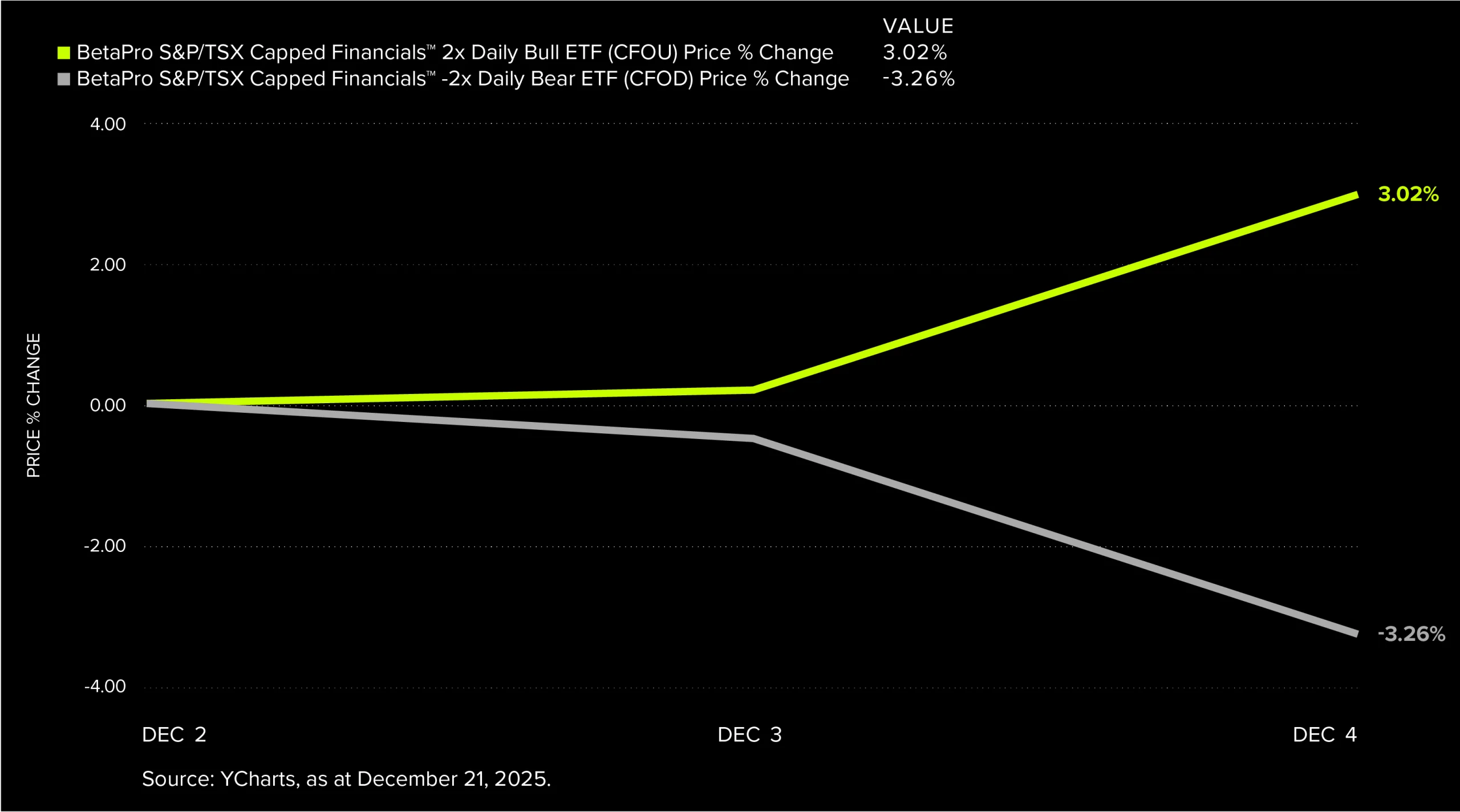
Here’s how the ETF moved during earnings season between December 2 and December 4, 2025. All six banks beat analyst earnings estimates, and the tone across reports was broadly positive. As a result, CFOU benefited from that bullish momentum.
There are many other times, though, where the inverse ETF would have been a better buy. For instance, during the quarter from May 23 to May 26, 2023, sentiment toward Canadian banks turned sharply negative. Many banks reported higher provisions for credit losses, while revenue growth slowed, and some bank-specific issues, such as TD abandoning a bid to acquire a U.S.-based bank and RBC reporting higher-than-expected expenses. In that environment, bearish positioning via CFOD benefitted.
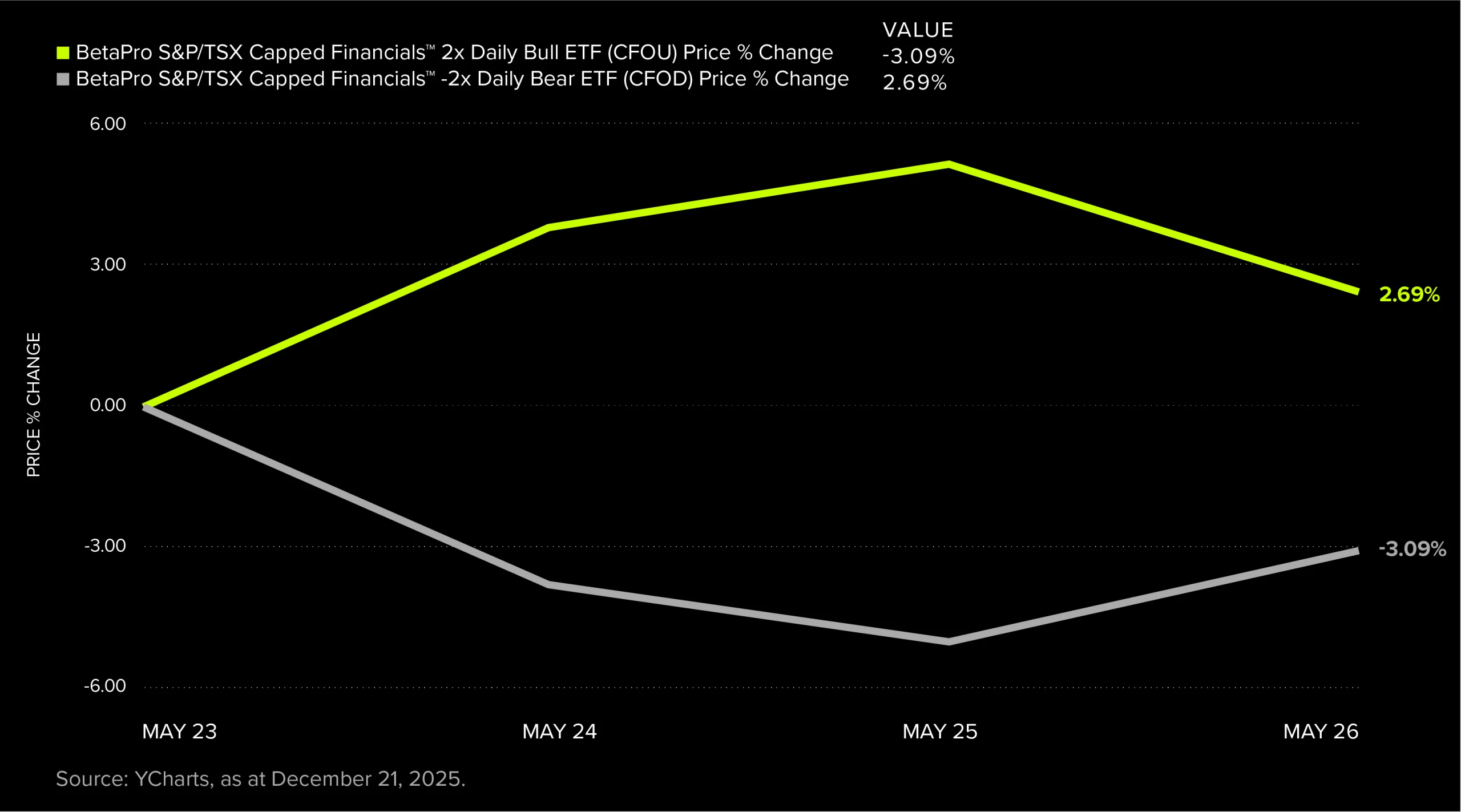
BetaPro’s financial ETFs are designed to provide daily exposure to the Canadian financial sector’s market volatility for a single day, while bank earnings can be spread across multiple days. Holding one of these funds through the entire bank reporting period may not match the sector’s cumulative performance for that period, due to daily rebalancing. Position sizing and timing matter, especially during compressed earnings weeks when sentiment can flip quickly from one report to the next.
For sophisticated traders, CFOU and CFOD could offer a more diversified and accessible way to express a bullish or bearish view on Canadian bank earnings without having to trade each stock on its own.
Disclaimers
Commissions, management fees and expenses all may be associated with an investment in products (the “Global X Funds”) managed by Global X Investments Canada Inc. The Global X Funds are not guaranteed, their value changes frequently and past performance may not be repeated. Certain Global Funds may have exposure to leveraged and inverse leveraged investment techniques that magnify gains and losses which may result in greater volatility in value and could be subject to aggressive investment risk and price volatility risk. Such risks are described in the prospectus. The prospectus contains important detailed information about the ETF. Please read the relevant prospectus before investing.
The Global X Funds include our BetaPro products (the “BetaPro Products”). The BetaPro Products are alternative mutual funds within the meaning of National Instrument 81-102 Investment Funds and are permitted to use strategies generally prohibited by conventional mutual funds: the ability to invest more than 10% of their net asset value in securities of a single issuer, to employ leverage, and engage in short selling to a greater extent than is permitted in conventional mutual funds. While these strategies will only be used in accordance with the investment objectives and strategies of the BetaPro Products, during certain market conditions they may accelerate the risk that an investment in shares of a BetaPro Product decreases in value.
The BetaPro Products consist of our Daily Bull and Daily Bear ETFs (“Leveraged and Inverse Leveraged ETFs”), Inverse ETFs (“Inverse ETFs”), and our BetaPro S&P 500 VIX Short-Term Futures™ ETF (the “VIX ETF”). The Leveraged and Inverse Leveraged ETFs and certain other BetaPro Products use leveraged investment techniques that can magnify gains and losses and may result in greater volatility of returns. These BetaPro Products are subject to leverage risk and may be subject to aggressive investment risk and price volatility risk, among other risks, which are described in their respective prospectuses. Each Leveraged and Inverse Leveraged ETF seeks a return, before fees and expenses, that is either up to or equal to either 200% or –200% of the performance of a specified underlying index, commodity futures index, or benchmark (the “Target”) for a single day. Each Inverse ETF seeks a return that is –100% of the performance of its Target. Due to the compounding of daily returns, a Leveraged and Inverse Leveraged ETF’s or Inverse ETF’s returns over periods other than one day will likely differ in amount and, particularly in the case of the Leveraged and Inverse Leveraged ETFs, possibly direction from the performance of their respective Target(s) for the same period. For certain Leveraged and Inverse Leveraged ETFs that seek up to 200% or up to -200% leveraged exposure, the Manager anticipates, under normal market conditions, managing the leverage ratio as close to two times (200%) as practicable however, the Manager may, at its sole discretion, change the leverage ratio based on its assessment of the current market conditions and negotiations with the respective ETF’s counterparties at that time. Hedging costs charged to BetaPro Products reduce the value of the forward price payable to that ETF.
The BetaPro Products include the 3x and -3x ETFs and will use leveraged investment techniques that can magnify gains and losses and may result in greater volatility of returns. These 3x and -3x ETFs are subject to leverage risk and may be subject to aggressive investment risk and price volatility risk, among other risks, which are described in their prospectus. Each 3x and -3x ETF seeks a return, before fees and expenses, that is equal to either 300% or –300% of the performance of a specified underlying index (the “Target”) for a single day. Due to the compounding of daily returns, a 3x and -3x ETF’s returns over periods other than one day will likely differ in amount and possibly direction from the performance of their respective Target(s) for the same period. Hedging costs charged to BetaPro Products reduce the value of the forward price payable to that ETF.
An investment in any of the BetaPro Products is not intended as a complete investment program and is appropriate only for sophisticated investors who have the capacity to absorb a loss of some or all of their investment. Please read the full risk disclosure in the prospectus before investing. Investors should monitor their holdings in BetaPro Products and their performance at least as frequently as daily to ensure such investment(s) remain consistent with their investment strategies.
Certain statements may constitute a forward-looking statement, including those identified by the expression “expect” and similar expressions (including grammatical variations thereof). The forward-looking statements are not historical facts but reflect the author’s current expectations regarding future results or events. These forward-looking statements are subject to a number of risks and uncertainties that could cause actual results or events to differ materially from current expectations. These and other factors should be considered carefully and readers should not place undue reliance on such forward-looking statements. These forward-looking statements are made as of the date hereof and the authors do not undertake to update any forward-looking statement that is contained herein, whether as a result of new information, future events or otherwise, unless required by applicable law.
This communication is intended for informational purposes only and does not constitute an offer to sell or the solicitation of an offer to purchase investment products (the “Global X Funds”) managed by Global X Investments Canada Inc. and is not, and should not be construed as, investment, tax, legal or accounting advice, and should not be relied upon in that regard. Individuals should seek the advice of professionals, as appropriate, regarding any particular investment. Investors should consult their professional advisors prior to implementing any changes to their investment strategies. These investments may not be suitable to the circumstances of an investor.
All comments, opinions and views expressed are generally based on information available as of the date of publication and should not be considered as advice to purchase or to sell mentioned securities. Before making any investment decision, please consult your investment advisor or advisors.
Global X Investments Canada Inc. (“Global X”) is a wholly owned subsidiary of Mirae Asset Global Investments Co., Ltd. (“Mirae Asset”), the Korea-based asset management entity of Mirae Asset Financial Group. Global X is a corporation existing under the laws of Canada and is the manager, investment manager and trustee of the Global X Funds.
© 2026 Global X Investments Canada Inc. All Rights Reserved.
Related Articles