
- Articles
- Insights
Bracing for Volatility? VIX Trading Explained
June 22, 2026Turn on any business news channel, and you’ll inevitably hear someone mention the VIX, or the CBOE Volatility Index. The VIX is the market’s go-to “fear gauge” for investor sentiment and how risk is being priced in on the S&P 500.
Of course, the VIX does more than validate that knot-in-your-stomach feeling – or that euphoric sense of optimism when markets are surging – it can also point to potential trading opportunities. Here’s how it works and why it can present tactical trading considerations for short-term investors.
How does the VIX work, exactly?
While investors view the VIX as a proxy for investor sentiment, the index actually measures expected volatility of the S&P 500. The index is calculated using S&P 500 options pricing, which reflects what investors are willing to pay to hedge against risk. In other words, the more demand for those options (or that protection), the greater the expected or implied volatility.
The VIX rises when investors anticipate price swings in the S&P 500 over the next 30 days and falls when stability is expected. Typically, high volatility (a VIX value above 30) means more dramatic price swings and greater uncertainty. Low volatility (a value below 20) indicates market stability and calm.
It’s important to stress, though, that the VIX doesn’t indicate which direction the market will move, only the intensity of expected changes.The VIX can rise during market rallies if investors expect future price swings.
How are VIX values calculated?
The short answer: it’s complicated. The long answer is that VIX calculations rely on real-time prices of S&P 500 Index (SPX) options traded on the CBOE Options Exchange. The VIX calculation uses both standard monthly and weekly SPX options, but only those with expirations between 23 and 37 days. And rather than using the last traded price, the VIX uses the midpoint between the bid and ask quotes for qualifying SPX options across a wide range of strike prices. These option prices are fed into a formula that estimates expected 30-day volatility in the S&P 500.
VIX values are constantly updated using snapshots of SPX option quotes taken every 15 seconds. These are called “spot” values because they reflect the market’s estimate of expected volatility at that moment.
So, what causes the VIX to spike and decline?
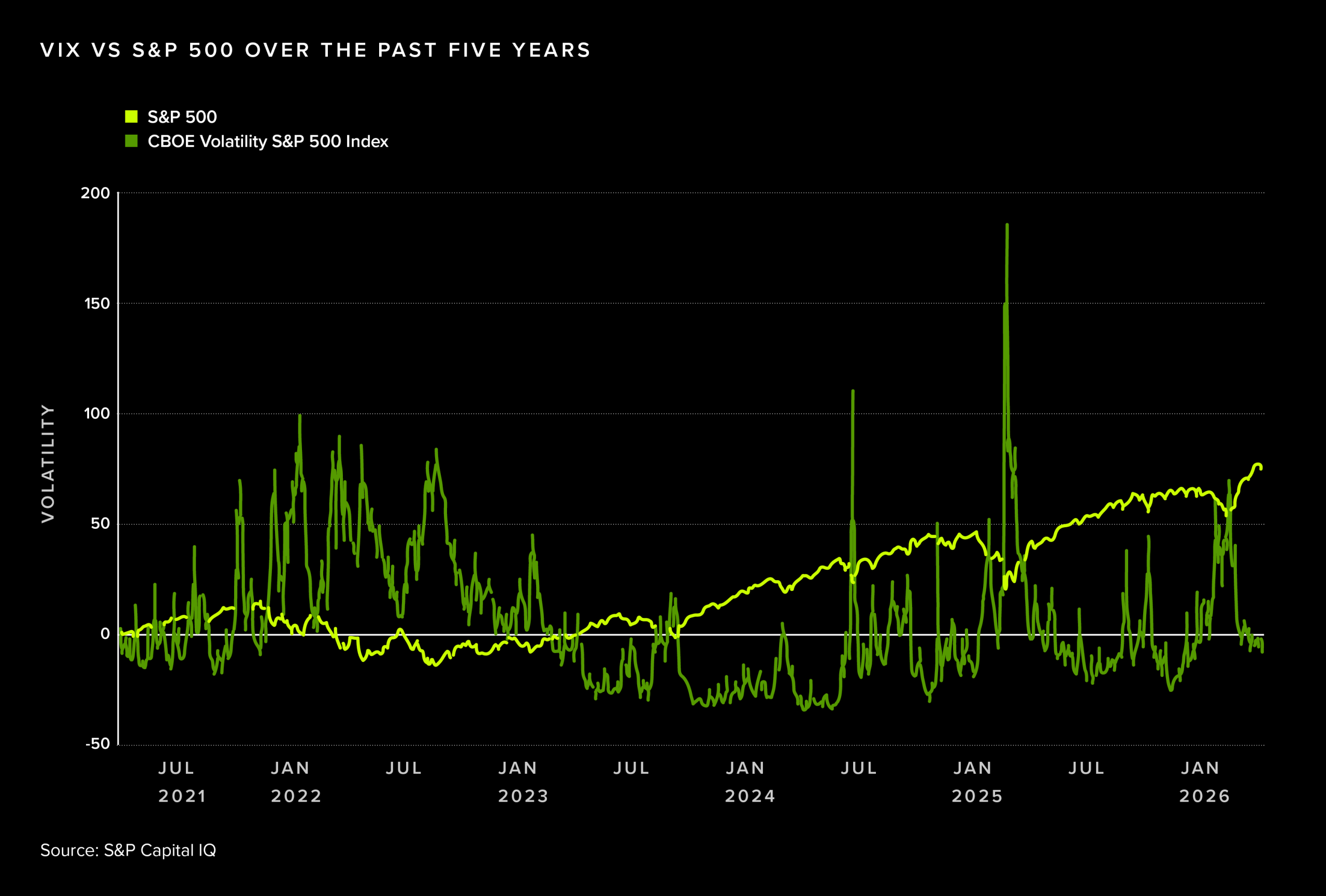
The VIX tends to spike during periods of market stress, such as sudden stock selloffs, as investors rush to hedge their positions with options, and retreats during steady, upward-trending markets when demand for protective options falls. These ups and downs can happen quickly.
Movements can also occur around scheduled recurring events, such as interest rate decisions, inflation data releases and monthly jobs reports. On December 18, 2024, for instance, the VIX climbed by nearly 74% after the U.S. Federal Reserve cut its interest rate, saying that subsequent cuts could come at a slower pace. (Source: S&P Capital IQ.)
Geopolitical events, such as wars or trade tensions, can also trigger sudden spikes in the index. We saw this happen back on March 27, 2026, when the VIX surged past 30, rising by 13% amid escalating tensions in the Middle East1. The last time the index was that high was in April 2025 – triggered by another geopolitical shock – when U.S. President Donald Trump announced sweeping global tariffs2.
Source:
1https://www.reuters.com/markets/us/wall-street-fear-gauge-flashes-red-stocks-extend-selloff-2025-04-07/
2https://ca.finance.yahoo.com/quote/%5EVIX/history/?period1=1743465600&period2=1779392068
Unexpected earnings results or regulatory announcements can also ripple through the options market, influencing VIX. It’s important to remember that even if the market is calm, the VIX can still jump if price swings are expected in the future.
Source: S&P Capital IQ
Can I trade the VIX?
Because the VIX is a calculation, not an asset, you can’t trade it directly like a stock or bond. But there are other ways to gain exposure to the index if you want to make a call on broader market volatility. One available approach is to use exchange-traded funds like BetaPro S&P 500 VIX Short-Term Futures™ ETF (VOLX). Designed for short-term speculation, VOLX aims to replicate the performance of the S&P 500 VIX Short-Term Futures Index, allows you to capitalize on evolving market changes.
Of course, it’s important to note that due to the nature of VIX futures and daily market movements, performance may differ materially from investor expectations. These products are generally intended for sophisticated investors and short-term trading strategies as they may experience significant volatility.
Historically, this index has often moved in the opposite direction of the S&P 500, meaning it rises when the stock market declines, providing a potential U.S. equity hedge during turbulent periods.
It’s worth noting, though, that VIX-based products like VOLX track VIX futures, not the spot VIX directly. Because of this, their performance can differ substantially from the headline VIX number. Like with any investment, traders should approach these products with caution and ensure that they align with their overall investment strategy and risk tolerance.
For short-term traders, volatility itself is the opportunity. While long-term investors may view market swings as something to ride out, active traders often look to periods of uncertainty or unexpected news as opportunities to make a move. Understanding how the VIX works and what’s driving it can help traders take advantage of rapidly changing market conditions.
DISCLAIMERS
Commissions, management fees and expenses all may be associated with an investment in products (the “Global X Funds”) managed by Global X Investments Canada Inc. The Global X Funds are not guaranteed, their value changes frequently and past performance may not be repeated. Certain Global Funds may have exposure to leveraged and inverse leveraged investment techniques that magnify gains and losses which may result in greater volatility in value and could be subject to aggressive investment risk and price volatility risk. Such risks are described in the prospectus. The prospectus contains important detailed information about the ETF.Please read the relevant prospectus before investing.
The Global X Funds include our BetaPro products (the “BetaPro Products”). The BetaPro Products are alternative mutual funds within the meaning of National Instrument 81-102 Investment Funds and are permitted to use strategies generally prohibited by conventional mutual funds: the ability to invest more than 10% of their net asset value in securities of a single issuer, to employ leverage, and engage in short selling to a greater extent than is permitted in conventional mutual funds. While these strategies will only be used in accordance with the investment objectives and strategies of the BetaPro Products, during certain market conditions they may accelerate the risk that an investment in shares of a BetaPro Product decreases in value.
The BetaPro Products consist of our Daily Bull and Daily Bear ETFs (“Leveraged and Inverse Leveraged ETFs”), Inverse ETFs (“Inverse ETFs”), and our BetaPro S&P 500 VIX Short-Term Futures™ ETF (the “VIX ETF”). The Leveraged and Inverse Leveraged ETFs and certain other BetaPro Products use leveraged investment techniques that can magnify gains and losses and may result in greater volatility of returns. These BetaPro Products are subject to leverage risk and may be subject to aggressive investment risk and price volatility risk, among other risks, which are described in their respective prospectuses.
The VIX ETF, which is a 1x ETF, as described in the prospectus, is a speculative investment tool that is not a conventional investment. The VIX ETF’s Target is highly volatile. As a result, the VIX ETF is not intended as a stand-alone long-term investment. Historically, the VIX ETF’s Target has tended to revert to a historical mean. As a result, the performance of the VIX ETF’s Target is expected to be negative over the longer term, and neither the VIX ETF nor its target is expected to have positive long-term performance.
An investment in any of the BetaPro Products is not intended as a complete investment program and is appropriate only for sophisticated investors who have the capacity to absorb a loss of some or all of their investment. Please read the full risk disclosure in the prospectus before investing. Investors should monitor their holdings in BetaPro Products and their performance at least as frequently as daily to ensure such investment(s) remain consistent with their investment strategies
Certain statements may constitute a forward-looking statement, including those identified by the expression “expect” and similar expressions (including grammatical variations thereof). The forward-looking statements are not historical facts but reflect the author’s current expectations regarding future results or events. These forward-looking statements are subject to a number of risks and uncertainties that could cause actual results or events to differ materially from current expectations. These and other factors should be considered carefully and readers should not place undue reliance on such forward-looking statements. These forward-looking statements are made as of the date hereof and the authors do not undertake to update any forward-looking statement that is contained herein, whether as a result of new information, future events or otherwise, unless required by applicable law.
This communication is intended for informational purposes only and does not constitute an offer to sell or the solicitation of an offer to purchase investment products (the “Global X Funds”) managed by Global X Investments Canada Inc. and is not, and should not be construed as, investment, tax, legal or accounting advice, and should not be relied upon in that regard. Individuals should seek the advice of professionals, as appropriate, regarding any particular investment. Investors should consult their professional advisors prior to implementing any changes to their investment strategies. These investments may not be suitable to the circumstances of an investor.
All comments, opinions and views expressed are generally based on information available as of the date of publication and should not be considered as advice to purchase or to sell mentioned securities.Before making any investment decision, please consult your investment advisor or advisors.
Global X Investments Canada Inc. (“Global X”) is a wholly owned subsidiary of Mirae Asset Global Investments Co., Ltd. (“Mirae Asset”), the Korea-based asset management entity of Mirae Asset Financial Group. Global X is a corporation existing under the laws of Canada and is the manager, investment manager and trustee of the Global X Funds.
© 2026 Global X Investments Canada Inc. All Rights Reserved.
Published June 22, 2026
Related Articles