
- Articles
- Insights
Semiconductors are soaring. Here’s why traders should pay attention.
July 28, 2026Amid all the AI hype, the semiconductor industry has been getting a lot of attention – and for good reason. Semiconductors form the foundation for chips, like CPUs and GPUs, that are critical to powering complex computations, running data centres and enabling AI applications. Thanks to the recent AI boom, the global semiconductor industry is expected to reach a record US$975 billion in sales this year alone.
Buy-and-hold investors participated in significant gains. The PHLX Semiconductor Index, better known as SOX, climbed more than 173 per cent in the 12 months ending June 22, 2026, as demand for AI infrastructure and data centres continued to surge.
Historically, though, semiconductors have been among the market’s most cyclical and volatile sectors, making them a favourite among active traders. The question now is whether AI has changed that dynamic.
No more boom-and-bust
For decades, the semiconductor industry followed a familiar boom-and-bust pattern. Rising demand for electronics such as smartphones, computers and gaming devices encouraged manufacturers to ramp up production and invest in new fabrication plants. As demand increased, so did prices, profits and stock valuations.
For decades, the semiconductor industry followed a familiar boom-and-bust pattern. Rising demand for electronics such as smartphones, computers and gaming devices encouraged manufacturers to ramp up production and invest in new fabrication plants. As demand increased, so did prices, profits and stock valuations.
However, demand would eventually cool. New production capacity would come online just as customers scaled back orders, creating excess supply and putting pressure on prices and earnings. That resulted in a highly cyclical industry characterized by periods of rapid growth and sharp slowdowns.
AI may be changing these patterns. Unlike smartphones or PCs, which are tied largely to consumer spending cycles, AI infrastructure spending is being driven by technology companies racing to build increasingly powerful models and data centres. That’s created a more steady source of demand for semiconductors.
Enter the ‘giga cycle’
Some analysts call this shift in semiconductor demand the “giga cycle,” a period of long-term structural growth driven by the widespread adoption of AI rather than traditional consumer demand. You might think then that a longer growth runway would make semiconductor stocks less volatile. In reality, as you can see from the chart below, which compares volatility between the SOX and the S&P 500, the opposite may be true. In fact, semiconductor stocks have become even more volatile when compared the S&P 500 as of late.
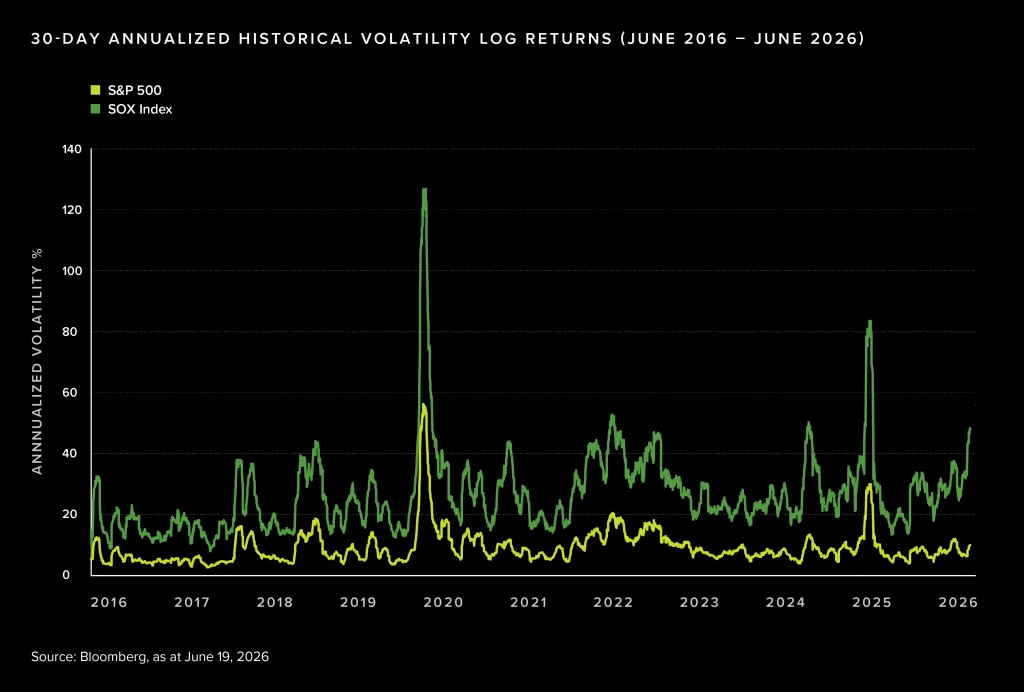
One reason for the higher volatility is because the industry is becoming increasingly divided between AI winners and everyone else. While demand for AI chips continues to surge, other semiconductor markets, including smartphones, PCs and automotive applications, have experienced slower growth. According to Deloitt, high-value AI chips are expected to account for roughly half of semiconductor industry revenue this year despite representing less than 0.2% of total unit volumes.
That kind of concentration can amplify volatility. Semiconductor stocks aren’t just responding solely to traditional supply-and-demand cycles, they’re also reacting to AI infrastructure spending plans, data-centre buildouts, earnings reports from major chipmakers and the pace of enterprise AI adoption. A single announcement from a company like Nvidia can influence sentiment across the entire sector.
The result is a market where long-term growth expectations remain strong, but short-term swings can still be significant. As you can see, the SOX is considerably more volatile than the S&P 500, even as AI demand has strengthened.
Volatility is here to stay
One of the big risks to semiconductor stocks is expectations, which have become exceptionally high. We know that AI will require more chips, more computing power and more data-centre infrastructure, but no one’s sure how that demand will materialize or whether current valuations already reflect that growth. (Bubble anyone?)
That’s a key reason why the sector can experience pullbacks even when its long-term outlook remains positive. Similar dynamics have played out in other high-growth themes, from gold to uranium, where strong fundamentals have supported a bullish long-term narrative but haven’t prevented significant short-term swings.
Semiconductor stocks also tend to amplify broader market moves. When markets rally, semiconductor shares often outperform. When markets pull back, those same stocks can experience larger declines. For active traders, that can create tactical trading setups. The long-term AI story may provide a supportive backdrop, but shorter-term performance is often driven by earnings reports, spending announcements, changes in market sentiment and broader market movements.
Then there are supply constraints and geopolitical developments, which can add another layer of uncertainty. Fabrication plants can take years and billions of dollars to build, making it difficult for supply to quickly respond to changes in demand. Export controls, trade restrictions and disruptions in key manufacturing hubs such as Taiwan and South Korea can also influence supply chains and investor sentiment.
Ultimately, the gigacycle may be extending the industry’s growth potential, but it hasn’t eliminated the ups and downs. Instead, it’s created a new set of catalysts capable of driving significant short-term moves.
Trading semiconductors through leveraged ETFs
If you’re looking for sector-level exposure to semiconductors, leveraged bull and bear ETFs offer a way to gain tactical exposure to market trends in either direction.
BetaPro offers two options: the BetaPro 3x Semiconductor Daily Leveraged Bull Alternative ETF (SOXL) and the BetaPro -3x Semiconductor Daily Leveraged Bear Alternative ETF (SOXS). Each ETF is designed to deliver either three times the daily move of the NYSE Semiconductor Index or three times the inverse of that daily performance.
Sophisticated daily traders can use these products as tactical tools around expected momentum or event-driven news such as earnings reports, AI infrastructure announcements, regulatory developments or shifts in investor sentiment. For instance, if a major chipmaker reports weaker-than-expected results and traders believe that could weigh on the broader semiconductor sector, they could use SOXS to express a bearish view.
There’s no question AI is reshaping the semiconductor market, but rising stocks may continue to offer an exciting destination for active traders. Before trading leveraged ETFs, though, you need to have a good understanding of these new market dynamics and a clear view of what catalyst could move the sector next. In a market where expectations can shift overnight, short-term volatility remains a powerful force.
Whether it’s an earnings report, an AI announcement, a policy change or a shift in investor sentiment, sophisticated active traders should expect plenty of movement ahead. The giga cycle may be changing where the sector is headed, but it hasn’t made the journey any smoother.
Disclaimers
Commissions, management fees and expenses all may be associated with an investment in products (the “Global X Funds”) managed by Global X Investments Canada Inc. The Global X Funds are not guaranteed, their value changes frequently and past performance may not be repeated. Certain Global Funds may have exposure to leveraged and inverse leveraged investment techniques that magnify gains and losses which may result in greater volatility in value and could be subject to aggressive investment risk and price volatility risk. Such risks are described in the prospectus. The prospectus contains important detailed information about the ETF. Please read the relevant prospectus before investing.
The Global X Funds include our BetaPro products (the “BetaPro Products”). The BetaPro Products are alternative mutual funds within the meaning of National Instrument 81-102 Investment Funds and are permitted to use strategies generally prohibited by conventional mutual funds: the ability to invest more than 10% of their net asset value in securities of a single issuer, to employ leverage, and engage in short selling to a greater extent than is permitted in conventional mutual funds. While these strategies will only be used in accordance with the investment objectives and strategies of the BetaPro Products, during certain market conditions they may accelerate the risk that an investment in shares of a BetaPro Product decreases in value.
The BetaPro Products consist of our Daily Bull and Daily Bear ETFs (“Leveraged and Inverse Leveraged ETFs”), Inverse ETFs (“Inverse ETFs”), and our BetaPro S&P 500 VIX Short-Term Futures™ ETF (the “VIX ETF”). The Leveraged and Inverse Leveraged ETFs and certain other BetaPro Products use leveraged investment techniques that can magnify gains and losses and may result in greater volatility of returns. These BetaPro Products are subject to leverage risk and may be subject to aggressive investment risk and price volatility risk, among other risks, which are described in their respective prospectuses. Each Leveraged and Inverse Leveraged ETF seeks a return, before fees and expenses, that is either up to or equal to either 200% or –200% of the performance of a specified underlying index, commodity futures index, or benchmark (the “Target”) for a single day. Each Inverse ETF seeks a return that is –100% of the performance of its Target. Due to the compounding of daily returns, a Leveraged and Inverse Leveraged ETF’s or Inverse ETF’s returns over periods other than one day will likely differ in amount and, particularly in the case of the Leveraged and Inverse Leveraged ETFs, possibly direction from the performance of their respective Target(s) for the same period. For certain Leveraged and Inverse Leveraged ETFs that seek up to 200% or up to -200% leveraged exposure, the Manager anticipates, under normal market conditions, managing the leverage ratio as close to two times (200%) as practicable however, the Manager may, at its sole discretion, change the leverage ratio based on its assessment of the current market conditions and negotiations with the respective ETF’s counterparties at that time. Hedging costs charged to BetaPro Products reduce the value of the forward price payable to that ETF.
The BetaPro Products include the 3x and -3x ETFs and will use leveraged investment techniques that can magnify gains and losses and may result in greater volatility of returns. These 3x and -3x ETFs are subject to leverage risk and may be subject to aggressive investment risk and price volatility risk, among other risks, which are described in their prospectus. Each 3x and -3x ETF seeks a return, before fees and expenses, that is equal to either 300% or –300% of the performance of a specified underlying index (the “Target”) for a single day. Due to the compounding of daily returns, a 3x and -3x ETF’s returns over periods other than one day will likely differ in amount and possibly direction from the performance of their respective Target(s) for the same period. Hedging costs charged to BetaPro Products reduce the value of the forward price payable to that ETF.
An investment in any of the BetaPro Products is not intended as a complete investment program and is appropriate only for sophisticated investors who have the capacity to absorb a loss of some or all of their investment. Please read the full risk disclosure in the prospectus before investing. Investors should monitor their holdings in BetaPro Products and their performance at least as frequently as daily to ensure such investment(s) remain consistent with their investment strategies.
Certain statements may constitute a forward-looking statement, including those identified by the expression “expect” and similar expressions (including grammatical variations thereof). The forward-looking statements are not historical facts but reflect the author’s current expectations regarding future results or events. These forward-looking statements are subject to a number of risks and uncertainties that could cause actual results or events to differ materially from current expectations. These and other factors should be considered carefully and readers should not place undue reliance on such forward-looking statements. These forward-looking statements are made as of the date hereof and the authors do not undertake to update any forward-looking statement that is contained herein, whether as a result of new information, future events or otherwise, unless required by applicable law.
This communication is intended for informational purposes only and does not constitute an offer to sell or the solicitation of an offer to purchase investment products (the “Global X Funds”) managed by Global X Investments Canada Inc. and is not, and should not be construed as, investment, tax, legal or accounting advice, and should not be relied upon in that regard. Individuals should seek the advice of professionals, as appropriate, regarding any particular investment. Investors should consult their professional advisors prior to implementing any changes to their investment strategies. These investments may not be suitable to the circumstances of an investor.
All comments, opinions and views expressed are generally based on information available as of the date of publication and should not be considered as advice to purchase or to sell mentioned securities. Before making any investment decision, please consult your investment advisor or advisors.
Global X Investments Canada Inc. (“Global X”) is a wholly owned subsidiary of Mirae Asset Global Investments Co., Ltd. (“Mirae Asset”), the Korea-based asset management entity of Mirae Asset Financial Group. Global X is a corporation existing under the laws of Canada and is the manager, investment manager and trustee of the Global X Funds.
© 2026 Global X Investments Canada Inc. All Rights Reserved.
Published July 28, 2026
Related Articles