
- Articles
- Insights
What past conflicts can teach us about volatility in a crisis
July 31, 2026Wars linger in our memories, but not on markets. The real impact comes early, in a sudden blast of volatility at the onset of any major conflict, when a stream of contradictory headlines can influence your investment decisions. After a few weeks, though, markets tend to calm down.
It’s in those early days when you see more exaggerated intraday swings, which, for short-term sophisticated traders, can lead to increased trading activity in leveraged and inverse-leveraged ETFs.
If you don’t want your capital to become collateral, you’ll need to build conviction in your investment ideas. To do that in an environment like this, it helps to understand how markets have reacted in past conflicts. Here’s how you can navigate markets in periods of uncertainty – even in wartime.
Find the pattern
Markets aren’t often as chaotic as they seem. Pick your conflict – the simmering U.S.-Iran War, Russia’s invasion of Ukraine, the U.S.-Iran War (2003) – and you start to see a similar pattern to emerge:
Initial reaction
Fear and volatility immediately spike at the outset of the conflict

Medium term
Markets stabilize as more information surfaces
Initial reaction
Investors refocus on fundamentals rather than headlines
Usually, volatility subsides within one to four weeks after the start of a major military escalation. According to research by MSCI, elevated volatility typically lasts about 20 days from the start of the conflict . That relatively short time is largely because many of the major conflicts in recent years have had a limited economic impact beyond the region, says MSCI. It’s not yet clear, of course, how long the current conflict will last and whether markets will remain volatile for longer.
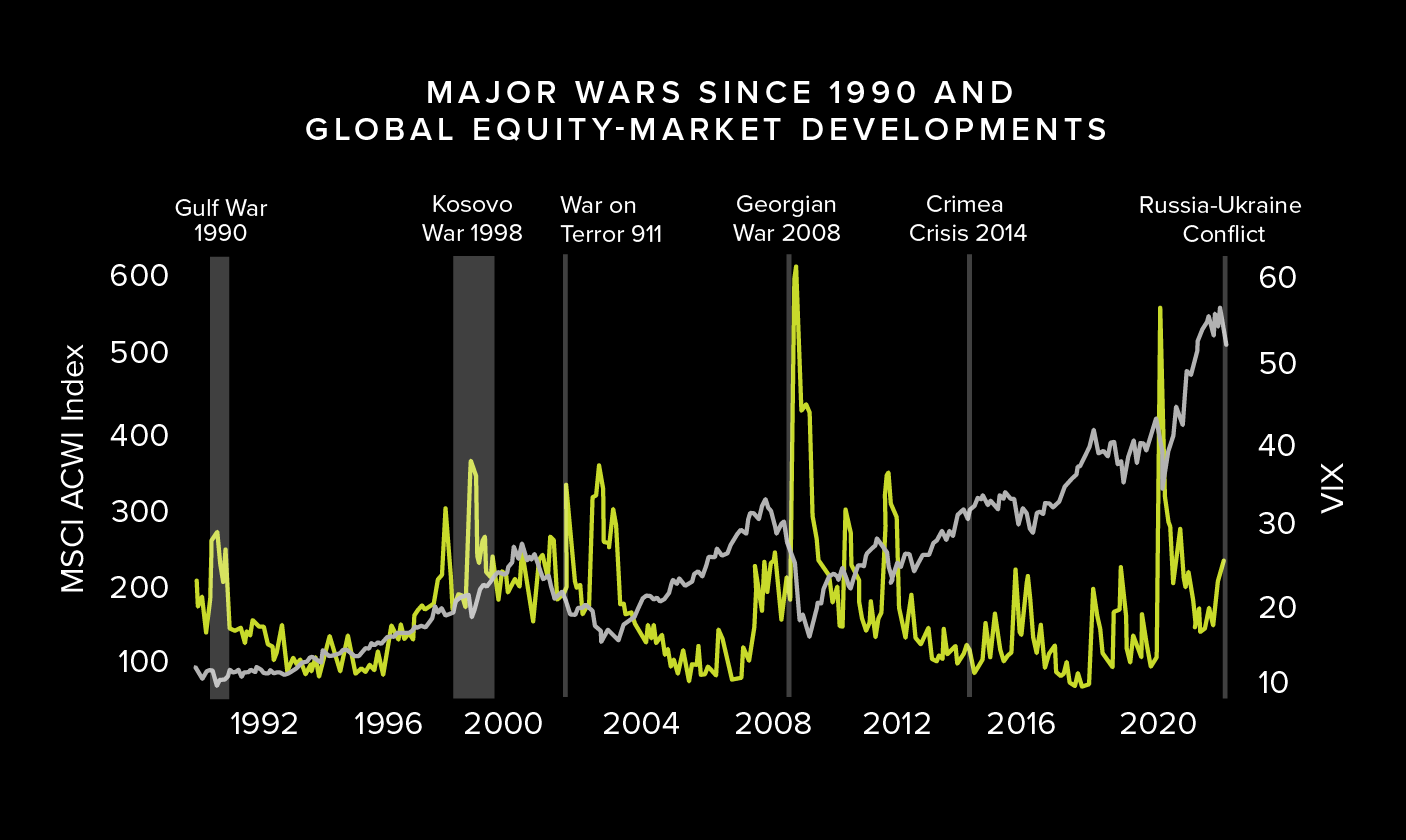
Source: “How modern wars affected market performance and volatility,” MSCI
If you look back over the past 20 major global conflicts, you’ll find that the S&P 500 fell an average of 6% from the first day of the conflict to the market trough. The depth and duration of the selloffs over those periods all followed this pattern, even if the conflict drags on for years. On average, the market took 28 days to get back to its pre-conflict levels.
Sectors more sensitive to conflict
Broad market selloffs at the start of hostilities can mask the volatility at the sector level, particularly in commodities like oil. More than a third of the 30 trading days since the outbreak of the U.S.-Iran war have seen oil prices rise and fall by more than 10%. At one point, prices surged nearly 70%.
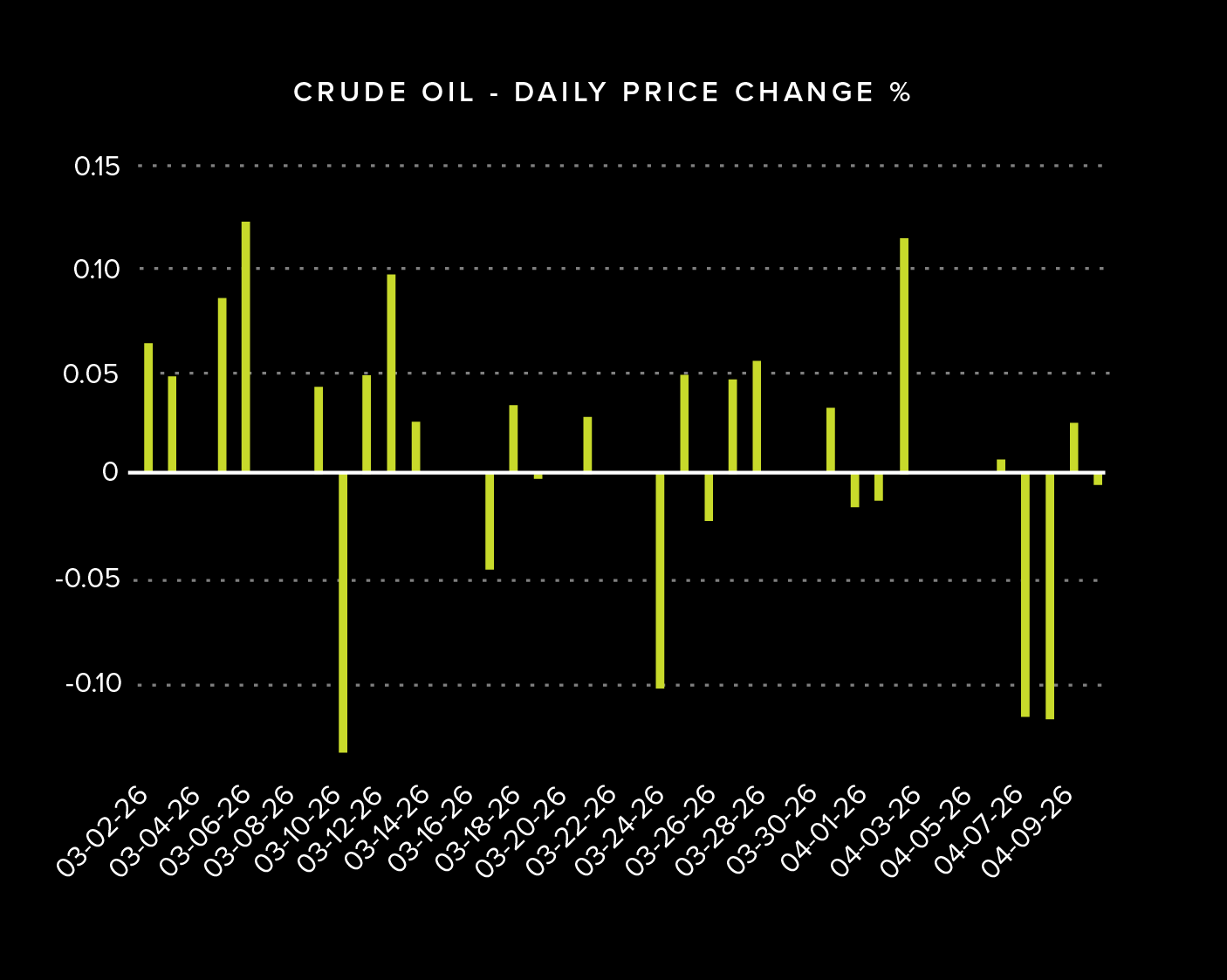
Source: Bloomberg, as at April 30, 2026
When U.S. President Donald Trump warned that Iran could be sent “back to the stone age” if it failed to reopen the Strait of Hormuz by April 6, crude prices climbed higher. However, given the extremity of the threat – and investors’ questioning the President’s propensity for extreme rhetoric – some traders viewed the deadline itself as a tactical opportunity rather than a directional signal.
On April 7, crude prices pulled back as immediate escalation failed to materialize. The BetaPro Crude Oil Inverse Leveraged Daily Bear ETF (HOD) that morning posted a 16% one-day gain, illustrating how geopolitical events can contribute to short-term market volatility.
Whether oil prices will continue to spike remains to be seen. A study by the Federal Reserve Bank of Dallas, looking at past conflicts that disrupted the global oil supply, found that oil price volatility is often driven more by fears that the global economy is slowing than by concerns about running out of oil. That suggests that oil markets could normalize relatively quickly if a resolution in the latest Middle East conflict is reached.
Conviction over guesswork
Uncertainty – and by extension – volatility tends to ease as the fog of war lifts. Even if a conflict continues to simmer, research shows that markets will adapt to the new normal. There’s already some indication that this adjustment is underway in the latest conflict.
At the time of writing, the CBOE VIX Index, which measures volatility based on S&P 500 index options, has fallen to levels not seen since early February. While unresolved conflict always carries the risk of sudden shocks to the markets, if you’re looking to navigate short-term movements, take a moment to understand what’s driving the volatility and how long those price spikes have historically lasted. Do that and you can protect yourself from any unnecessary self-inflicted wounds.
DISCLAIMERS
Commissions, management fees and expenses all may be associated with an investment in products (the “Global X Funds”) managed by Global X Investments Canada Inc. The Global X Funds are not guaranteed, their value changes frequently and past performance may not be repeated. Certain Global Funds may have exposure to leveraged and inverse leveraged investment techniques that magnify gains and losses which may result in greater volatility in value and could be subject to aggressive investment risk and price volatility risk. Such risks are described in the prospectus. The prospectus contains important detailed information about the ETF. Please read the relevant prospectus before investing.
The Global X Funds include our BetaPro products (the “BetaPro Products”). The BetaPro Products are alternative mutual funds within the meaning of National Instrument 81-102 Investment Funds and are permitted to use strategies generally prohibited by conventional mutual funds: the ability to invest more than 10% of their net asset value in securities of a single issuer, to employ leverage, and engage in short selling to a greater extent than is permitted in conventional mutual funds. While these strategies will only be used in accordance with the investment objectives and strategies of the BetaPro Products, during certain market conditions they may accelerate the risk that an investment in shares of a BetaPro Product decreases in value.
The BetaPro Products consist of our Daily Bull and Daily Bear ETFs (the “Leveraged and Inverse Leveraged ETFs”), Inverse ETFs (the “Inverse ETFs”), and our BetaPro S&P 500 VIX Short-Term Futures™ ETF (the “VIX ETF”) and can offer opportunities for enhanced returns or hedging strategies, but it’s essential to understand and accept the associated risks. Leveraged ETFs aim to amplify the returns of an underlying index, which can lead to higher gains, but they also magnify losses in downturns. Similarly, inverse ETFs seek to profit from declines in the underlying index, meaning they can perform inversely to the market, but losses can accumulate quickly if the market moves against expectations. While these strategies will only be used in accordance with the investment objectives and strategies of the BetaPro Products, during certain market conditions they may accelerate the risk that an investment in shares of a BetaPro Product decreases in value. Investors should be aware of and understand their risk tolerance and capacity, and conduct their research before investing. An investment in any of the BetaPro Products is not intended as a complete investment program and is appropriate only for investors who have the capacity to absorb a loss of some or all of their investment. Please read the full risk disclosure in the prospectus before investing. Investors should monitor their holdings in BetaPro Products and their performance at least as frequently as daily to ensure such investment(s) remain consistent with their investment strategies.
An investment in any of the BetaPro Products is not intended as a complete investment program and is appropriate only for sophisticated investors who have the capacity to absorb a loss of some or all of their investment. Please read the full risk disclosure in the prospectus before investing. Investors should monitor their holdings in BetaPro Products and their performance at least as frequently as daily to ensure such investment(s) remain consistent with their investment strategies.
Certain statements may constitute a forward-looking statement, including those identified by the expression “expect” and similar expressions (including grammatical variations thereof). The forward-looking statements are not historical facts but reflect the author’s current expectations regarding future results or events. These forward-looking statements are subject to a number of risks and uncertainties that could cause actual results or events to differ materially from current expectations. These and other factors should be considered carefully and readers should not place undue reliance on such forward-looking statements. These forward-looking statements are made as of the date hereof and the authors do not undertake to update any forward-looking statement that is contained herein, whether as a result of new information, future events or otherwise, unless required by applicable law.
This communication is intended for informational purposes only and does not constitute an offer to sell or the solicitation of an offer to purchase investment products (the “Global X Funds”) managed by Global X Investments Canada Inc. and is not, and should not be construed as, investment, tax, legal or accounting advice, and should not be relied upon in that regard. Individuals should seek the advice of professionals, as appropriate, regarding any particular investment. Investors should consult their professional advisors prior to implementing any changes to their investment strategies. These investments may not be suitable to the circumstances of an investor.
All comments, opinions and views expressed are generally based on information available as of the date of publication and should not be considered as advice to purchase or to sell mentioned securities. Before making any investment decision, please consult your investment advisor or advisors.
Global X Investments Canada Inc. (“Global X”) is a wholly owned subsidiary of Mirae Asset Global Investments Co., Ltd. (“Mirae Asset”), the Korea-based asset management entity of Mirae Asset Financial Group. Global X is a corporation existing under the laws of Canada and is the manager, investment manager and trustee of the Global X Funds.
© 2026 Global X Investments Canada Inc. All Rights Reserved.
Published July 31, 2026
Related Articles