
- Articles
- Insights
Understanding Order Types With Leveraged and Inverse Leveraged ETFs
September 8, 2026Anyone who’s been behind the wheel of a car knows the faster you go, the longer it takes to safely stop. That principle also applies to trading leveraged or inverse-leveraged ETFs. In a fast-moving market, speed can quickly become a liability if the markets turn, especially when you’re using 2x or 3x leveraged funds that can amplify smaller moves – up or down.
For sophisticated traders interested in using leveraged and inverse leveraged ETFs, there are strategies that can help you manage your potential exits. Here’s how.
Managing potential downside with stop orders
One way to control risk when trading leveraged and inverse-leveraged ETFs is through the stop order, which is also referred to as stop-loss orders.
Stop orders are instructions given to a broker to sell a falling investment at a pre-set price – even within a single trading day. While they can be useful to help guard against long-term declines, they can also help control intraday volatility, which is critical when using leveraged and inverse-leveraged ETFs.
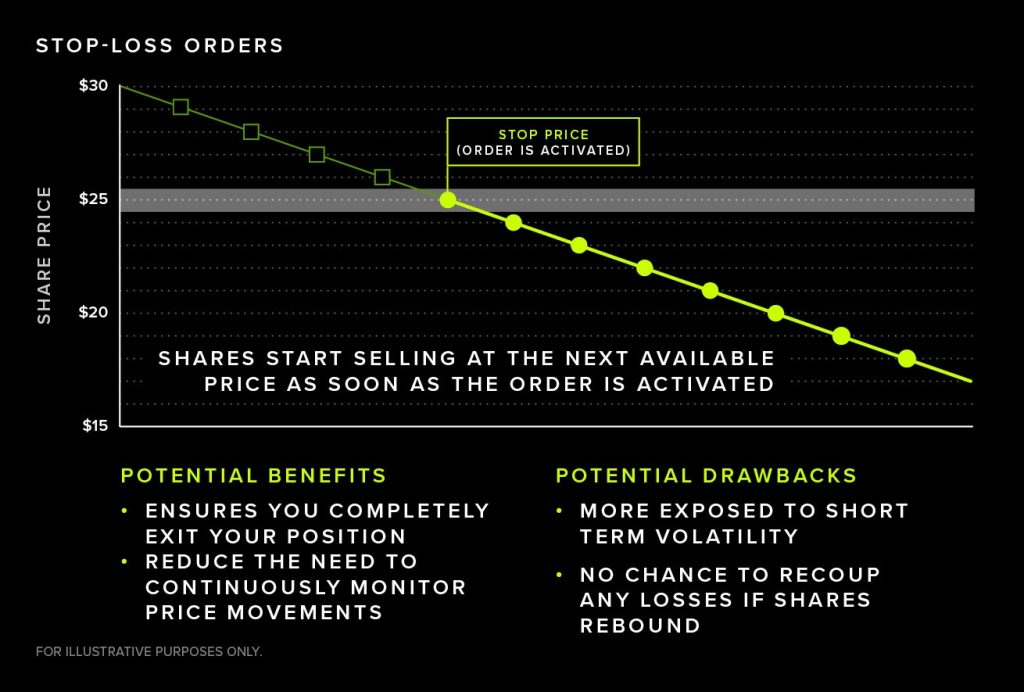
These tools can help keep trading focused on discipline rather than emotion, which can be useful if your thesis doesn’t play out the way you envisioned. For example, you could buy a 3x ETF at $30 and set a stop price of $29.10, which 3% below the purchase price. While this scenario results in a loss, it’s a tool that could potentially mitigate a larger selloff.
One issue with stop loss orders is that if the market drops suddenly, you may not exit at $29.10. Rather, the order will trigger at the next best available price. Still, having a stop order in place is better than reacting on the fly in a market where a leveraged product can move quickly in minutes.
Understanding stop-limit orders
If you would rather have more control over when you sell a falling security, consider using a stop-limit order. It works like a regular stop order by triggering when a price level is hit, but you can also set a limit order at the same price or lower where the trade executes. Essentially, you’re setting the worst price you’ll take so you avoid a stop loss order situation where you have to accept whatever price you get.
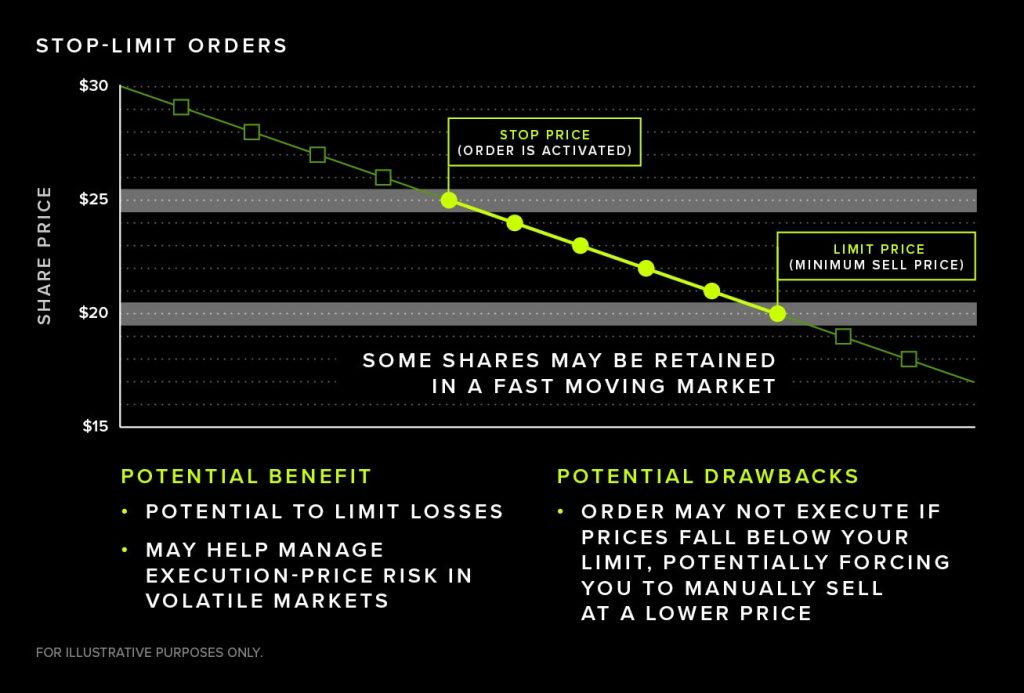
Let’s revisit the earlier example of an ETF trading at $30. You might set a stop at $29.10 and a limit at $28.50, roughly a 5% drop. Once the ETF hits $29.10, the order becomes a limit order that will only fill at $28.50 or better. If the price falls too quickly and trades below $28.50 before a fill can occur, the order won’t execute.
And that’s the risk: if the ETF plummets past the limit order too quickly, then your trade won’t fill at all, forcing you to sell later at an even lower price. Stop limits are typically used by traders who are concerned about poor execution during fast, news-driven moves and are comfortable with the risk that the order may not execute.
Trailing stops: Take gains as a trade rises
There is also a type of stop order that can allow you to adjust your exit levels as prices change under volatile conditions: the trailing-stop-limit order. While not available on every brokerage platform, this order type allows you to set a trailing percentage, say 3%, that adjusts automatically as the ETF’s price moves higher.
Suppose your 3x ETF rises 7% shortly after you buy it, which is possible with leveraged ETFs and volatile asset classes. With a 3% trailing-stop-limit, your stop price would move up alongside the ETF, sitting 3% below its highest point.
If the ETF then pulled back by 3%, the stop would trigger and convert to a limit order, which will only execute at your specified limit price or better. This allows you to potentially lock in a portion of the gain while still giving the trade room to run. However, in fast-moving markets, there is no guarantee a trade will execute when it reaches your set price. Prices can continue to fall before a buyer is found, meaning your units may be sold at a lower price than expected.
This type of order can be useful during macro events, such as major economic releases or U.S. Federal Reserve announcements, when markets often jump sharply and then retrace. A trailing stop helps you participate in the move without constantly adjusting your exit level.
Trailing stops also help reduce second-guessing. When markets move quickly, traders often debate whether to take profits early or hold on and risk giving gains back. A trailing stop-limit automates that decision, helping you capture at least some profits if momentum fades — while keeping you aware of the risk that, in a very fast drop, the order may not fill.
Understanding time-based auto exits
Some traders choose to exit a position not based on price, but on time. Certain trading platforms let you set a time-based auto-sell that closes your position after a defined window, whether the ETF rises, falls or barely moves. For example, you might choose to hold a leveraged ETF only during the first hour after a U.S. jobs report. If the trade hasn’t played out by then, the platform automatically closes it.
This approach allows you to trade a specific event more deliberately. Once the window you’re targeting has passed, the reason to stay in the position may no longer exist. Instead of waiting until the end of the day to sell, you exit precisely when the opportunity you were aiming to capture is over.
How “one-cancels-the-other” orders work
While protecting the downside is important, you may also want to ensure you lock in gains. Leveraged and inverse-leveraged ETFs can fall quickly, but they can also rise fast if the market moves in your favour. If your ETF jumps by 5% in a day, you might want to take that profit instead of risking a reversal later on.
One strategy some platforms allow is an OCO (one-cancels-the-other) order. An OCO pairs a profit-taking limit order with a stop-loss; if one executes, the other is cancelled immediately. For example, you might set a stop-loss 2% below your purchase price and a limit order to sell if the ETF rises by 4%.
If the market rallies, the limit order may execute, potentially realizing a gain. If the market reverses, the stop order may execute, but the execution price and resulting gain or loss will depend on market conditions. Either way, the decision is made before the trade begins, not in the heat of the moment.
While stop-losses seem like safety nets, this is one tool sophisticated traders may consider be core parts of a leveraged and inverse-leveraged strategy, especially in fast-moving, short-term markets.
A defined plan and clear approach can help inform decisions during periods of market volatility. Instead of letting emotions or volatility force your hand, use discipline and planning to dictate your next move.
DISCLAIMERS
Commissions, management fees and expenses all may be associated with an investment in products (the “Global X Funds”) managed by Global X Investments Canada Inc. The Global X Funds are not guaranteed, their value changes frequently and past performance may not be repeated. Certain Global Funds may have exposure to leveraged and inverse leveraged investment techniques that magnify gains and losses which may result in greater volatility in value and could be subject to aggressive investment risk and price volatility risk. Such risks are described in the prospectus. The prospectus contains important detailed information about the ETF. Please read the relevant prospectus before investing.
The Global X Funds include our BetaPro products (the “BetaPro Products”). The BetaPro Products are alternative mutual funds within the meaning of National Instrument 81-102 Investment Funds and are permitted to use strategies generally prohibited by conventional mutual funds: the ability to invest more than 10% of their net asset value in securities of a single issuer, to employ leverage, and engage in short selling to a greater extent than is permitted in conventional mutual funds. While these strategies will only be used in accordance with the investment objectives and strategies of the BetaPro Products, during certain market conditions they may accelerate the risk that an investment in shares of a BetaPro Product decreases in value.
The BetaPro Products consist of our Daily Bull and Daily Bear ETFs (the “Leveraged and Inverse Leveraged ETFs”), Inverse ETFs (the “Inverse ETFs”), and our BetaPro S&P 500 VIX Short-Term Futures™ ETF (the “VIX ETF”) and can offer opportunities for enhanced returns or hedging strategies, but it’s essential to understand and accept the associated risks. Leveraged ETFs aim to amplify the returns of an underlying index, which can lead to higher gains, but they also magnify losses in downturns. Similarly, inverse ETFs seek to profit from declines in the underlying index, meaning they can perform inversely to the market, but losses can accumulate quickly if the market moves against expectations. While these strategies will only be used in accordance with the investment objectives and strategies of the BetaPro Products, during certain market conditions they may accelerate the risk that an investment in shares of a BetaPro Product decreases in value. Investors should be aware of and understand their risk tolerance and capacity, and conduct their research before investing. An investment in any of the BetaPro Products is not intended as a complete investment program and is appropriate only for investors who have the capacity to absorb a loss of some or all of their investment. Please read the full risk disclosure in the prospectus before investing. Investors should monitor their holdings in BetaPro Products and their performance at least as frequently as daily to ensure such investment(s) remain consistent with their investment strategies.
An investment in any of the BetaPro Products is not intended as a complete investment program and is appropriate only for sophisticated investors who have the capacity to absorb a loss of some or all of their investment. Please read the full risk disclosure in the prospectus before investing. Investors should monitor their holdings in BetaPro Products and their performance at least as frequently as daily to ensure such investment(s) remain consistent with their investment strategies.
Certain statements may constitute a forward-looking statement, including those identified by the expression “expect” and similar expressions (including grammatical variations thereof). The forward-looking statements are not historical facts but reflect the author’s current expectations regarding future results or events. These forward-looking statements are subject to a number of risks and uncertainties that could cause actual results or events to differ materially from current expectations. These and other factors should be considered carefully and readers should not place undue reliance on such forward-looking statements. These forward-looking statements are made as of the date hereof and the authors do not undertake to update any forward-looking statement that is contained herein, whether as a result of new information, future events or otherwise, unless required by applicable law.
This communication is intended for informational purposes only and does not constitute an offer to sell or the solicitation of an offer to purchase investment products (the “Global X Funds”) managed by Global X Investments Canada Inc. and is not, and should not be construed as, investment, tax, legal or accounting advice, and should not be relied upon in that regard. Individuals should seek the advice of professionals, as appropriate, regarding any particular investment. Investors should consult their professional advisors prior to implementing any changes to their investment strategies. These investments may not be suitable to the circumstances of an investor.
All comments, opinions and views expressed are generally based on information available as of the date of publication and should not be considered as advice to purchase or to sell mentioned securities. Before making any investment decision, please consult your investment advisor or advisors.
Global X Investments Canada Inc. (“Global X”) is a wholly owned subsidiary of Mirae Asset Global Investments Co., Ltd. (“Mirae Asset”), the Korea-based asset management entity of Mirae Asset Financial Group. Global X is a corporation existing under the laws of Canada and is the manager, investment manager and trustee of the Global X Funds.
© 2026 Global X Investments Canada Inc. All Rights Reserved.
Published September 8, 2026
Related Articles